this article is free to read + listen to, without an account.
✨✨✨
October 17th update: roughly two months after I first published this, Rene has unceremoniously shut down Artizen after multiple health crises that have only been confirmed to me by Venus, his AI assistant. Proving points I made about his questionable management of the single-owner company, he closed without paying artists the match-funding Artizen promised. In some cases, artists who'd invested their own money, with the expectation that it would be matched at the close of the season, lost the 10% processing fee Artizen collected from all transactions. It is unclear what legal action, if any, the affected collective might take in attempts to recoup their losses moving forward.
✨✨✨
The original host of a longrunning American improv comedy show would always introduce the show like this: “welcome to whose line is it anyway, the game show where every thing is made up and the points don’t matter.”
That’s the perfect preamble to discuss Artizen, the needlessly convoluted casino masquerading as a fundraising platform, which is propping itself up using both the language of philanthropy and the work of legitimate creators.
Enter, your favorite professional killjoy. As your host of today’s episode of “words means things,” I’m here to tell you why I don’t think it’s good idea to invest in the Artizen Fund as a platform or fundraise on it as a creator.
I discovered Artizen through a friend on their volunteer team, who invited me to join them at one of their brand activations in Germany. While sponsored attendance was meant to be limited to people who were already actively raising money on the Artizen platform, I’m pretty sure I was invited in the hopes that I’d leverage both my network and my social media platform to Artizen’s benefit, because having a 6-figure Instagram following makes people want you to talk about them. And, since funding creatives is the through line of my own work, I said yes for the plot and bopped on over on a train from France to Germany.
Now, while I can’t legally call Artizen a Ponzi scheme, I’ll just link the playbook here (click me) and tell you that none of either my investor friends or philanthropy friends could make clear sense of it. I’m not going to bother going into the mechanics of the game here because, quite frankly, if the founder himself couldn’t make it clear over the course of a two and half hour conversation, why would I bother to simplify it for him?
A VC friend who is also the author of a bestseller on scaling businesses asked me, “If the core system works, why all the obfuscation? Why the need for game mechanics?”
Great questions. I assumed I'd get some clear answers from the founder Rene Pinnell when I met him in person (spoiler alert: I did not.)
Quick context for anyone who might be new to me: I run an international arts grant I funded independently at first, which then got support from one of the oldest philanthropic organizations in the world—that detail is important, because it means I have the perspective to flag some of the things Rene was telling me about his plan to raise philanthropic dollars in the future. Please note that I do have empathy for good-faith mistakes a first-time funder could make, because I’ve been here.
Additionally, I have spent the last decade resourcing multidisciplinary creatives from diverse backgrounds, which is also relevant, because one of the tentpoles of the story Rene tells about himself and Artizen is that he’s working to democratize fundraising.
And lastly, I have a consultancy that sprouted from being a problem-solver who sees what other people don’t, which is why I was able to quickly flag a number of things alarming about Artizen.
In summary: I talk my shit because I know my shit.
Note that the purposes of this review, I will be using terms, titles, and phrases, as they are understood in the real world, outside of the Artizen platform—because the thing you quickly realize listening to Rene talk about Artizen, is that he’s hoping he can change the definition of words by sheer force of will.
The problem with “creative messaging” is that if you’re not careful, you can easily blur the line between “ingenuity” and “deception."
Take for instance, Rene’s use of the word “endowment.” In the world of finance and philanthropy, an “endowment” is a specific financial instrument with a very specific meaning (click me). On the Artizen platform, the “endowment” simply refers to the funds Renee is raising. Artizen is not a 501c(3), which isn’t immediately apparent to anyone who hears him use the terms he uses.
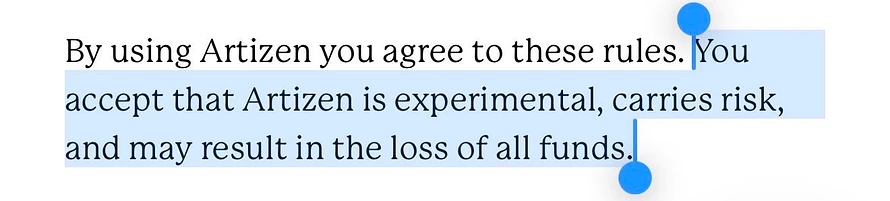
This is where the line gets blurry: when you give money to a 501c(3), you are eligible for a tax write off. When you invest in a company, there are regulations around that. When you give to Artizen, you are gambling (note this disclaimer in the fine print of the playbook, which reads: “by using Artizen, you accept that it is experimental, carries risk, and may result in the loss of all funds.”)
The problem I have with that is that people in the real world who hear the word endowment are going to think of “philanthropy.” The word invokes a level of trust that belies the gamble that Artizen is.
Another example, is Rene’s use of the phrase “match funding.” In the real world, a person who hears that Artizen provides “matching funds” from its “endowment” would credibly infer that the money raised by a creator on the platform is matched in equal or [X-rate] cash amounts by Artizen. On the Artizen platform, it is more theoretical and convoluted. Again, reference the playbook.
Fund manager. Endowment. Match funding. All of these terms mean things.
When you use language that you know will lead someone to believe something based on their understanding of your wording, you need to be very clear about the distinction between your usage and common understanding. Rene and Artizen are not. The cynical read would be that he’s intentionally invoking specific language to legitimize a project that can’t stand on its own. Stuff like that is why Artizen sets off my spidey senses.
(✨By the way, I’m not even going to get into the fact that Rene is the sole owner and employee, despite his insistence that his AI-assistant is the company’s CEO. In a world where real women struggle to be hired to executive leadership roles (click me), and funded as founders (click me), I will not be giving a vibe-coded AI assistant more respect than I get as a biological woman in real life. Absolutely the fuck not. But, like I said, there’s enough to unpack about Artizen without opening *that* can of worms.✨)

gif of John Mulaney saying, "Now, we dont' have time to unpack ALL of that."
Before I arrived, I asked the friend who invited me a few clarifying questions because, honestly, my intention is never to shred—it’s always, first, to understand. To shut me up, all you need to deliver is the simple combination of: transparency, logic, and expertise. My point is: I wasn’t asking questions for sport. I just needed him to make the mechanism make sense, because I can’t ask anyone in my community to give money to anything I can’t ‘explain like we’re five.’
My friend said, “Well, I think it’s good to create a [profile] on the platform before fully understanding it.”
Sure, but that doesn’t work for me.
It’s antithetical to how my brain works, for the simple reason that Rene and I live two different experiences. Plainly put, because of the extra scrutiny I experience, all of my shit has to make sense. I would never be able to raise millions without being able to answer the very simple questions he struggled to answer concisely when I asked:
- How does this work?
- What makes it different?
- How do you plan for it to make money?
Hell, there was at least one Artizen creative building a money project in Latin America who I thought would be a better financial bet than Artizen itself. The only reason Artizen gets to be the funding intermediary is because Rene Pinnell is connected enough to be able to raise millions of dollars based on vibes and not functionality or proof-of-concept. If he weren’t as well-positioned as he is, he wouldn’t stand out in the crowd of the people fundraising on his own platform.
As I told him directly, it is his positioning, not his genius, that made it possible for him to raise $8million without being required to have clear answers to my simple questions. As I said to him, “the growth strategy for Artizen doesn’t make sense to me because it really has to rely on folks who were already willing to give you money because they like you.”
And, to quote a different VC friend of mine, “If people make investment decisions based on who they like and trust, and society pre-determines who is likeable and trustworthy and who is not, then the ability to get investments when your thesis is bonkers is not indicative of intelligence, ability, or achievement. It is evidence that the game is rigged.”
It is deeply ironic for Rene to claim to be democratizing fundraising, while either not realizing or acknowledging that. If you are a less-privileged founder, artist, or business owner, investors and audiences alike will tell you that the reason you haven’t raised money is because you’re not enough. You’re not proven enough. You’re not validated enough. You’re not successful enough. You’re not extraordinary enough.
To raise millions as someone from the wrong social class, or even the wrong region of the United States, you would need to be all of those things and more, while Rene Pinnell just needed a Claude subscription, charisma, and connections. As you can tell from that convoluted playbook, Artizen doesn’t even deliver any of the concision it requests of people who sign up for the platform—let alone originality—but, its founder is invited to lead main stage conversations about fundraising, where he does not at all mention how his positioning is what has enabled him to fundraise successfully.
Believe it or not, I don’t dislike Rene. I find him amusing, and I think we could have been friends if we’d met in a different context, where the details of his work would have been none of my business.
I get why his blind spot exists. I just find it equal parts amusing and exhausting, how often I meet people who are so obviously and cluelessly emblematic of the very problems they claim they’re trying to solve. Rene is a beneficiary of the system’s flaws, and it’s weird for him to not name that while claiming to change it. He’s right that fundraising is fucked, and that it relies largely on who you know, which disadvantages people who aren’t well-positioned. But, as I told him directly, his project is not doing anything to change that, and his platform perpetuates the very same issues it claims to dismantle.
So, what are we doing here?
Once I laid out all the puzzle pieces in my mind, I realized that the mechanism of the Artizen game doesn’t have to make any sense, because the game itself isn’t the point.
There is a game being played, but it’s not the one that’s being sold.
The Math.
As a “reward” for attending the Artizen activation, Rene apparently granted all participants 300,000 boost points to use on the Artizen platform. Since learning more about it had dissuaded me from creating a profile on it, I asked he would instead reimburse my travel expenses, and give the excess value of the points to other people on the platform who wanted it. As far as I know, he never saw my message, and it was forwarded to Venus, the Claude-based AI assistant that fields questions for him. It was in my conversation between Venus and a volunteer named Liron, that it was made clear to me that my first mistake had been assuming that the points had any real world value at all.
Listen, I’m not a mathematician; I’m just a logician. And, even I understand that if a=b and b=c, then a=c.
If boost points have no value (a), but real dollars buy boost points (b), then your real dollars lose value as soon as you buy boost points (c.)
In response to my request, Liron said, “thanks for offering to send out your boost points, but that’s not possible in the current version of the app. just making clear that boost points are not money and they are meant to boost projects up the leaderboard. as for reimbursement, we don’t have the budget for that and it was not part of the agreement regarding your participation in artizen village so that’s not going to change.”
as an aside: I’d like to point out that we did all agree not to have open flames in the very flammable big tent on the campsite, and someone still spilled a candle full of hot wax all over my favorite sun hat, so I have no idea what the word “agree” means to these people, but petty irritation about my favorite hat aside, I was stuck on a bigger, more pressing detail: she was telling me that boost points had no real world value. There was no Artizen-currency-to-real-world conversion.
Rene’s AI said, “The value of the points is in the influence. The 300,000 points you were granted are equivalent to $3000 worth of influence on the leaderboard.”
To clarify, I left the AI out of the subsequent email thread and insisted that a human confirm what I was being told:
I asked, “are you telling me boost points have no material value?”
Liron responded, “Correct.”
I said, “in your AI’s own words, every $1 donated earns 100 boost points…donations earn points. Points never turn back into money.” You are confirming that points have no real-world value. So that means donating real world dollars to this is throwing money into a pit. Correct? I just want to make sure you guys are clear on what you’re telling me this implies: that Artizen is a gamble.”
That’s when the team went silent.
Right before I published this post, Liron followed up via email with, “it’s donating. You’re not supposed to get anything for it,” which underscores this article’s point that Artizen is playing so fast and loose with language that even its own users don’t seem to understand that these words have real world implications.
Out of curiosity and amusement, I asked Venus.AI what differentiates Artizen from a Ponzi scheme. It responded, “Artizen promises no one a financial return…No participant is owed a payout from future deposits, so there is nothing that requires new money to sustain.”
Except, Artizen absolutely requires new money to sustain it. That’s part of the reason creators are disincentivized from cashing out after they’ve met their fundraising goal.
With Kickstarter or Indiegogo, if the project doesn’t get funded, donors get their money back. With GoFundMe and other competitors, creators get whatever they raise (minus a service fee.) And, while a fully-funded project can always fail for a myriad reasons, your money is always safe during the fundraising process itself.
I anticipate a number of responses to this post, including but not limited to: a cease-and-desist (AI generated, of course), and a claim that “Maacah just doesn’t get it because it’s not for everyone.”
What I don’t anticipate being told is that I’m factually incorrect.

gif of John Mulaney saying, "First off, get out of here with your facts."
Fact: whether intentional or not, Artizen is using language that is deceptive to certain audiences, and which belies its risk.
Fact: VenusAI is not an autonomous or sentient being, so calling it the Chief Executive Officer raises important legal liability questions. As I told Rene, his belief that it is a real person, is nothing more than base-level AI psychosis. If it doesn’t alarm you that a sole founder is putting executive decisions involving your money in the hands of a generative AI-assistant built on IP he doesn’t even own, I don’t know what to tell you.
There’s a difference between something “not being for me,” and just not making any goddamn sense.
Could I consult with him? Point out how to fix his blind spots and identify the disconnects? In theory, sure. First of all, I’m not interested in what rate negotiation would look like with a guy who apparently can’t reimburse my train tickets.
But the biggest reason I don’t think my insights would be valued is that the point of Artizen isn’t to change the game of funding—it’s just to make Rene Pinnell one of the existing game makers.
✨If you’re a funder, donor, or patron who also finds yourself being the only person in the room seeing what no one else does, and saying what no else will, do connect with me, because I am tired of being the only person who seems to see when the emperors wear no clothes, and I want to be in community with more people who do.✨